
Play
Pause
00:00
Frankly, I don’t think that political awareness is going to prove the best medicine for our current malady. Most people know that financial dictatorship is destroying their life; the problem is knowing what to do about it. It is possible that nothing can be done, that power has become so deeply entrenched in the automatisms regulating daily life, connecting our interchanges, and infiltrating our words, that bio-financial control cannot be undone, or avoided.
So what can be done when nothing can be done?
I think that ironic autonomy is the answer. I mean the contrary of participation, I mean the contrary of responsibility, I mean the contrary of faith. Politicians call on us to take part in their political concerns, economists call on us to be responsible, to work more, to go shopping, to stimulate the market. Priests call on us to have faith. If you follow these inveiglements to participate, to be responsible — you are trapped. Do not take part in the game, do not expect any solution from politics, do not be attached to things, do not hope.
Dystopian irony (dyst-irony) is the language of autonomy. Be sceptical: do not believe your own assumptions and predictions (or mine).
And do not revoke revolution. Revolt against power is necessary even if we may not know how to win.
Do not belong. Distinguish your destiny from the destiny of those who want to belong and to participate and to pay their debt. If they want war, be a deserter. If they are enslaved but want you to suffer like them, do not give in to their blackmail.
If you have to choose between death and slavery, don’t be a slave. You have some chance to survive. If you accept slavery, you will die sooner or later anyway. As a slave.
You will die anyway; it is not particularly important when. What is important is how you live your life.
—Franco ‘Bifo’ Berardi, Heroes, (London: Verso, 2015), 224-225.
Ω Ω Ω
Wir sind die letzte Generation mit Hoffnungen gewesen. Wir hatten die große Hoffnung, daß eine menschlichere Gesellschaft auf der ganzen Welt möglich ist. Ob diese Hoffnung nun berechtigt war oder nicht und ob unser Beitrag der richtige gewesen ist, bleibe mal dahingestellt. Doch diese Hoffnung kann heute niemand mehr haben, der bei klarem Verstand ist und sich auch nur einen Tag lang die Nachrichten anhört.…Es sieht rabenschwarz aus.
Ich meine allerdings: Ob man nun noch einen Hoffnungsschimmer sieht oder nicht, man sollte auf jeden Fall etwas tun. Die Hoffnung auf den Fünfjahresplan, die gibt es nicht mehr. Aber Herrschaft zu bekämpfen, dort wo sie ungerecht oder unerträglich wird, für eine solidarische, menschlichere Welt eintreten, das solltest du zumindest in deiner näheren Umgebung versuchen. Sonst bist du auf jeden Fall verloren.
—Bommi Baumann, 1991 introduction to »Wie alles anfing«, (Berlin: Rotbuch Verlag GmbH, 2007), 7-8.
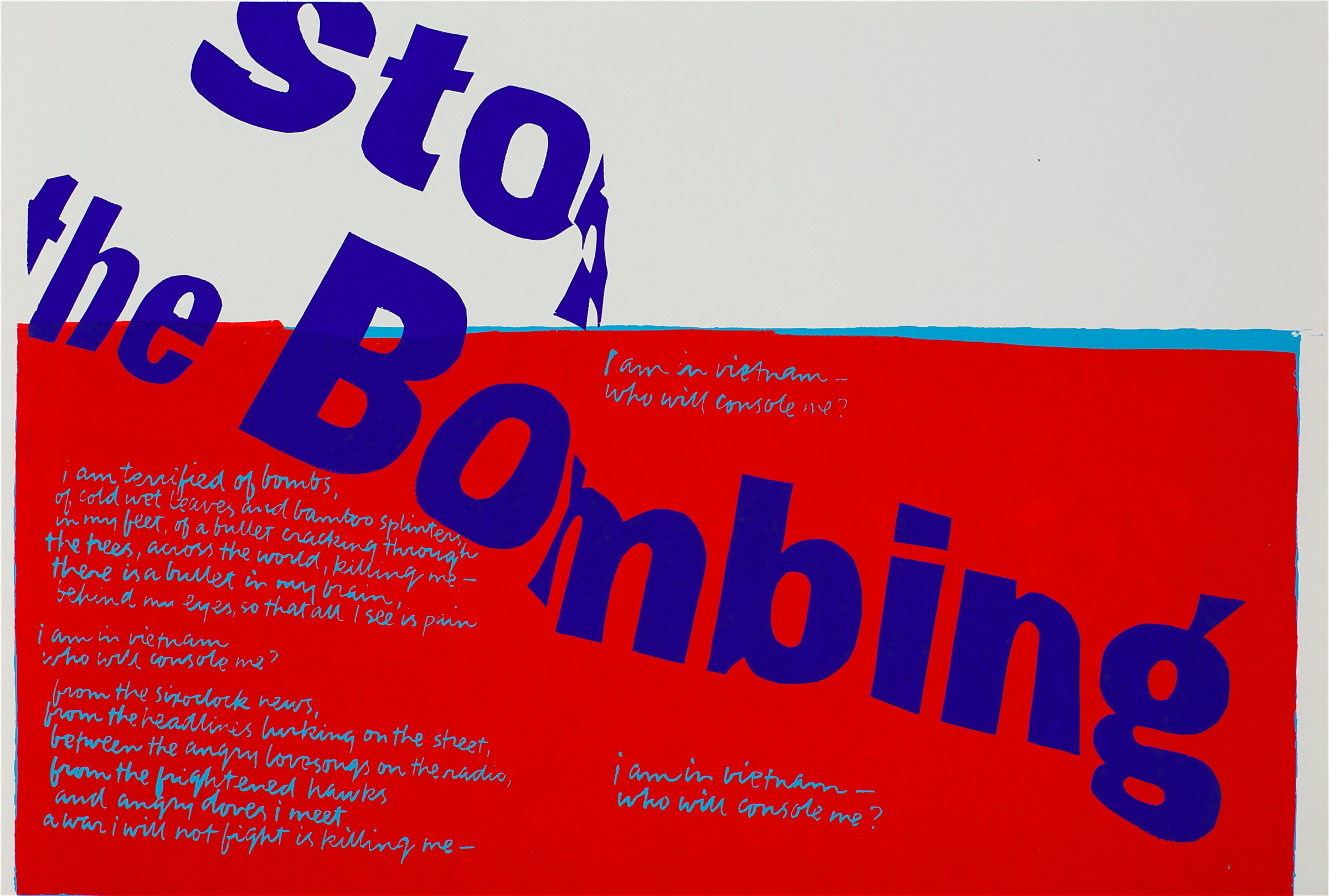
This is by Corita Kent, 1967. I grew up with a framed print over the sofa in my family’s living room. The War, by which anybody and everybody meant The Vietnam War, was ever a constant. It was there, a fact of life, in the background perhaps half forgotten, brought to the fore when the family car passed a troop convoy on the highway. The War was the peace sign on my jacket, the peace sign graffiti on overpasses, the symbol carved into the desks at school, on silver pendants, earrings. The War was always there.
It occurred to me this morning that the Forever Wars of the US in the 21st Century are similarly always there, background or not. Missing, however, are the peace signs.
During the next few days he realised how isolated he was. It was no one’s fault, he thought. He had simply got what he had asked for.
His friends had become strangely dim and colourless. Not one of them had kept his own outlook, his own world. They had been much more vivid in his memory. He must have over-estimated them in the past.
—Boris Pasternak, Doctor Zhivago, (London: Vintage, 2002), 160.
France has ordered Russian journalist Xenia Fedorova to leave the country, the interior ministry said on Wednesday, amid accusations that she has spread Kremlin propaganda through French television and radio ahead of next year’s presidential election.
France has ordered controversial Russian journalist Xenia Fedorova to leave the country, the interior ministry said Wednesday, after accusations that she was churning out Kremlin propaganda on French television and radio.
Disinformation experts have raised the alarm about the influence of the former journalist for Russia’s state-run channel RT, as France heads for a presidential election next year.
French newspaper Liberation cited the expulsion order as accusing her of acting “as a conduit for disinformation campaigns orchestrated by the Russian authorities” with the aim of “destabilising public order” in France.
…
She regularly appears on the CNews television channel, Europe 1 radio and writes a column for Le Journal du Dimanche, spreading Kremlin talking points about Ukraine and the West.
There is no clarification here as to what it means, exactly, to “destabilise public order”, or how “spreading talking points” is in any way illegal.

I have never read before that I may expect a response within 60 business days. This is from a unit of the United States Government which “is committed to responding to your message in a timely manner”.

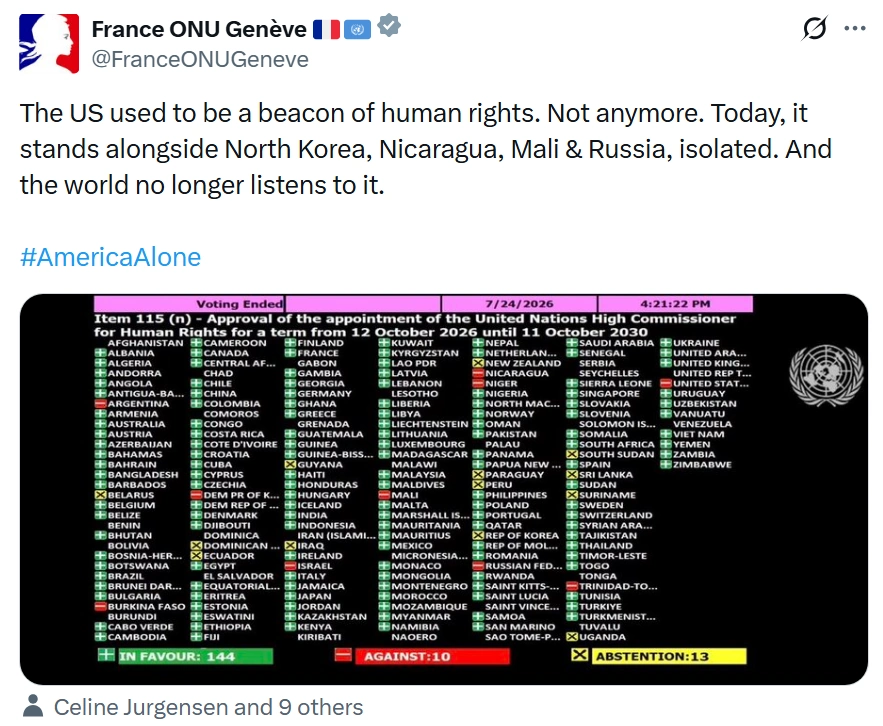
In Modernity and the Holocaust, Zygmunt Bauman argues that for all the incontestable novelty of the Nazi genocide against the Jews, its essential message lies in what it tells us about modernity and its peculiar mindset, rationality and institutions, thus about something general, to be found in other places and nations, within other political movements and therefore facilitating that something like it will happen again.
—Arne Johan Vetlesen, “Reassessing Modernity and the Holocaust in the light of genocide in Bosnia”, in Revisiting Modernity and the Holocaust, eds. Jack Palmer and Dariusz Brzeziński, (London: Routledge, 2022), 111.
Noch grundsätzlicher ließe sich fragen, was ein Staat seinen Bürgern, die auf seinen Befehl hin ihr Leben lassen sollen, an Bemühungen schuldet, den Krieg, dem sie zum Opfer fallen könnten, gar nicht erst stattfinden zu lassen. Hier könnten gegenseitige Pflichten von Staaten aus dem Völkerrecht ins Spiel kommen, die man auch, zumal in Demokratien, als Pflichten gegenüber ihren Bürgern lesen könnte. Kann ein Staat einen moralischen Anspruch darauf erheben, dass von ihm ausgewählte Bürger auf seinen Befehl hin bereit sind zu sterben oder sich lebenslang verstümmeln zu lassen, wenn er nicht vorher alles getan hat, um ihnen dies zu ersparen? Zu denken wäre hier beispielsweise an Artikel 33 (1) der Charta der Vereinten Nationen:
Ω Ω Ω
In Deutschland könnte für die Frage der Legitimität einer Wehrpflicht des Weiteren auch der Umstand ins Gewicht fallen, dass es wohl kaum ein anderes Land gibt, in dem so wenig an strategischer Diskussion über nationale Interessen und nationale Sicherheit stattfindet wie hier. Seit dem Ende des Zweiten Weltkriegs ist das deutsche Militär und sind die deutschen »Verteidigungspolitiker« nicht deutsch, sondern atlantisch orientiert, mit gelegentlichen gaullistischen Ausbruchsversuchen, die aber immer frühzeitig beendet wurden.
This morning I felt like I was reading something in a sort of a fantasyland. The idea that this German state, busily producing weapons for the Israelis to use in massacring Palestinian civilians, is going to consider its duty to German citizens because of some obligation under international law, because of the Charter of the United Nations? It just reads as unreal, a voice from a previous era.
Streeck rings true, of course. I look for, and fail to find, public debate of German national interests, just as I used to try to engage German coworkers in any sort of discussion. Topics such as Israel and Ukraine are quite clearly beyond question. I’ve been impressed several times when I simply tried to raise the idea of talking about the background to the Russian invasion, or the causes for the Palestinian break-out from Gaza, and gotten the very explicit response that these points were not up for discussion.
